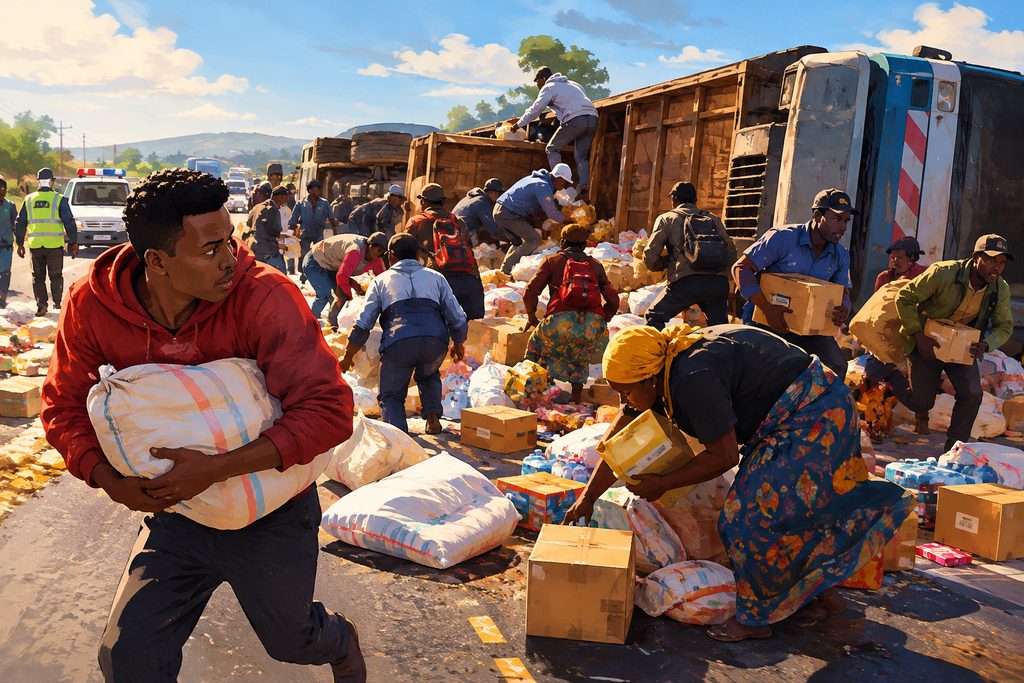
There is a scene that seems to repeat itself with worrying regularity on Kenyan roads. A lorry overturns, its cargo spills onto the road, and within minutes, a crowd gathers. But often, they are not there to help. They are there to help themselves.
Sacks of maize, crates of soda, bales of clothes and, in some of the most dangerous cases, fuel from overturned tankers suddenly become opportunities. People gather in broad daylight, watching and sometimes encouraging one another as they carry away goods that still belong to someone else.
What disturbs me is not only the act itself, but how easily it can become a collective activity. Some people have even lost their lives trying to collect fuel from overturned tankers, yet the behaviour continues.
As a psychologist, this raises a question for me: What happens when wrongdoing becomes normal within a group?
The Legal Reality We Conveniently Forget
When a lorry overturns, ownership of its cargo does not change. Goods lying on a public road do not automatically become public property.
Kenya’s Penal Code addresses theft under Sections 268 and 275, while Section 279 covers specific circumstances involving theft of goods in transit. An accident does not give members of the public the right to take whatever they can carry.
But beyond the law, I am interested in the gap between knowing what is right and doing what is wrong when circumstances change.
Why might someone who would ordinarily condemn stealing participate in it simply because many others are doing the same?
Understanding the Psychology of the Crowd
Social psychology reminds us that human behaviour does not occur in isolation. We observe others, interpret their actions and sometimes adjust our behaviour accordingly.
Imagine arriving at an accident scene and seeing one person taking goods. You might question it. But when you see dozens or hundreds doing the same, the behaviour can begin to appear normal.
This is where conformity, social norms and deindividuation become important.
Conformity helps explain how people adjust their behaviour to what others are doing. Deindividuation describes how, in certain group settings, people may experience a reduced sense of individual identity and personal accountability.
The question can shift from “What am I doing?” to “What are we doing?”
This does not mean people lose their understanding of right and wrong. Rather, the social environment can weaken the influence of their personal judgement in that moment. Someone who might never steal alone may behave differently when surrounded by others doing the same.
Closely related to this is diffusion of responsibility. When many people participate, each individual may feel that their contribution is insignificant.
“I only took one.”
“Everyone was taking something.”
“Someone else would have taken it anyway.”
Yet responsibility does not disappear because it is shared among a crowd. The collective result of these seemingly small decisions may be an entire lorry’s cargo disappearing.
How We Justify What We Know Is Wrong
Psychologist Albert Bandura’s concept of moral disengagement helps us understand how people distance themselves from the moral consequences of their actions.
We change the language. We call it picking rather than stealing. We tell ourselves the owner is insured, the goods were damaged, or the company will not miss them. We may even convince ourselves that taking something is acceptable because everyone else is doing it.
The person does not necessarily stop knowing that the goods belong to someone else. Instead, they find a way to justify their actions while continuing to see themselves as a decent person.
There is another troubling aspect: some people take goods without knowing exactly what they are, whether they need them or what they will do with them.
This suggests that material need alone cannot explain the behaviour. Opportunity, social influence and perceived scarcity may also play a role. Economic pressure can make an immediate gain particularly attractive, but poverty does not automatically make someone dishonest, nor does it excuse taking another person’s property.
Psychology is not only concerned with condemning behaviour. It also asks why that behaviour becomes appealing to the person engaging in it.
When the Opportunity Is Dangerous
Perhaps the most painful example is fuel siphoning from overturned tankers.
People know fuel is highly flammable. We have witnessed the deaths and destruction that can follow. Yet another overturned tanker can still attract a crowd.
One possible explanation is how we assess risk in groups. When many people engage in a dangerous activity, their presence may create a false sense of safety. An individual may unconsciously assume that if so many people are doing it, the risk must be manageable.
But the presence of a crowd does not reduce the danger. Fuel does not become less explosive because dozens of people are standing around a leaking tanker.
This is also a question of social learning. We may witness the consequences of dangerous behaviour, feel shocked for a while, and still return to familiar patterns when another opportunity arises.
Knowing that something is dangerous does not always translate into behaving safely.
The Uncomfortable Mirror: Petty Looting and Grand Corruption
This brings me to a question I find uncomfortable.
We complain about corruption, the misuse of public resources and leaders who use positions of authority for personal gain. And rightly so.
But could some of the attitudes that support small acts of dishonesty also exist, in different forms, within the larger problem of corruption?
I am not suggesting that every Kenyan who condemns corruption would steal public money if given the opportunity. That would be an unfair conclusion. But perhaps we should ask ourselves:
What would I do if I had access to something that did not belong to me, nobody was watching, and I believed I could get away with it?
At an accident scene, the opportunity may be a crate of goods. In a position of power, it may involve public resources. The scale and consequences are vastly different, but some of the justifications can sound familiar.
“Everyone does it.”
“Nobody will know.”
“I deserve it.”
“Someone else would have taken it.”
These similarities do not make ordinary citizens and corrupt leaders the same. They invite us to examine how dishonesty can be rationalised in different settings.
We cannot demand integrity from people in positions of power while treating dishonesty as acceptable whenever we personally benefit from it.
What Kind of Behaviour Are We Making Normal?
I would be careful about defining a society by its worst behaviour. There are Kenyans who return what does not belong to them, refuse to exploit another person’s misfortune and walk away from opportunities to benefit unfairly, even when nobody is watching.
So perhaps the question is not whether we are naturally dishonest as a people. It is what kind of behaviour we are making normal.
Culture is shaped through repetition. When dishonesty is repeatedly witnessed, tolerated or justified, it can gradually become accepted. When honesty is practised and wrongdoing is challenged, different social norms can emerge.
This is why the conversation about corruption cannot only be about politicians. It must also include the everyday moments in which our own values are tested: receiving more change than we should, finding another person’s property, or standing beside an overturned lorry while everyone around us takes what does not belong to them.
These moments may appear small, but they reveal something about the values we practise when an opportunity presents itself.
Perhaps changing a society’s relationship with dishonesty requires more than condemning those at the top. It also requires examining the behaviour we tolerate at the bottom, in the middle and everywhere in between.
Because societies are not built only in Parliament, boardrooms or government offices. They are also built on our roads, in our homes, in our workplaces and in the decisions we make when nobody is watching.
What do we choose when we have the opportunity to take what does not belong to us?
Perhaps that is where the psychology of a society begins.
0 Comments