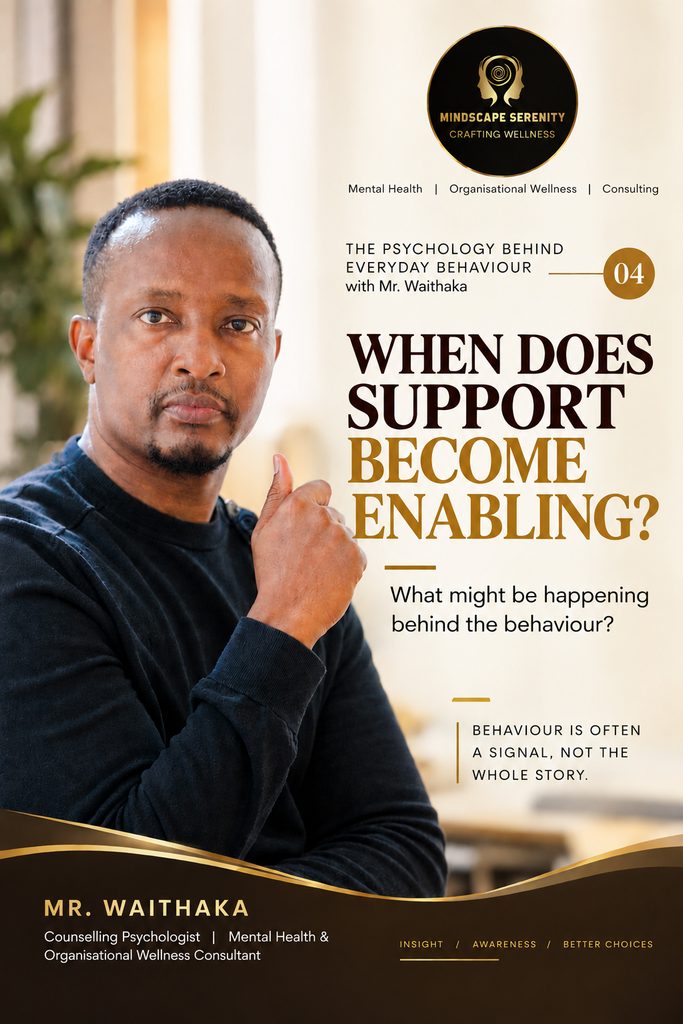
Supporting someone we care about is often an expression of love, compassion and responsibility. We offer help when people struggle, stand beside them during difficult seasons and sometimes make sacrifices to help them find their footing again.
But an important psychological question arises: at what point does helping someone begin to protect the very behaviour that is hurting them?
The answer is not always straightforward because support and enabling can look remarkably similar on the surface.
A parent may repeatedly rescue an adult child from the consequences of irresponsible decisions. A partner may keep covering up for behaviour that is damaging the relationship. A friend may continually provide money without addressing a recurring pattern of harmful choices.
In the workplace, a manager may repeatedly correct an employee’s mistakes without addressing the underlying performance problem. Colleagues may consistently take over another person’s responsibilities to avoid conflict or ensure that deadlines are met.
In each situation, the intention may be good. The difficulty lies in what the pattern gradually reinforces.
Psychologically, human behaviour is influenced not only by what happens before an action, but also by what follows it. When a person repeatedly experiences relief from the consequences of a behaviour because someone else intervenes, there may be little immediate motivation to change that behaviour.
For example, if an employee consistently misses deadlines but colleagues always complete the work on their behalf, the immediate problem may be resolved. However, the underlying pattern can continue, while responsibility and pressure are transferred to other team members.
Over time, this can affect workplace morale, accountability, trust and psychological well-being. The people who continually compensate for others may experience frustration, exhaustion and burnout, particularly when their own responsibilities begin to suffer.
A similar pattern can develop in families and relationships. One person becomes the rescuer, while the other increasingly depends on being rescued. What begins as occasional assistance can gradually become an established expectation.
This does not mean that every act of assistance is enabling. People experience genuine difficulties, including mental health challenges, financial hardship, illness and circumstances beyond their control. Sometimes, meaningful support requires substantial practical help, patience and continued care.
The distinction lies in whether our help supports a person’s capacity to move forward or repeatedly removes the need to address a harmful pattern.
In mental health, this distinction requires particular sensitivity. Someone experiencing depression, addiction or another psychological difficulty may need professional support, structured treatment and compassionate assistance. Withdrawing help simply to force them to face consequences can deepen their difficulties rather than promote change.
Equally, allowing harmful behaviour to continue without boundaries is not necessarily compassion.
We must learn to distinguish between supporting a person and taking responsibility for choices that belong to them.
Sometimes, genuine support means helping someone access treatment rather than continually managing the consequences of their condition. It may mean offering guidance without controlling every decision, or communicating clear boundaries while remaining emotionally available.
In organisations, it may mean providing an employee with appropriate training, reasonable adjustments, supervision and opportunities to improve, while maintaining clear expectations and accountability.
The goal is not punishment. It is to create conditions in which responsibility, growth and healthier behaviour become possible.
There is also a psychological dimension that we sometimes overlook: the rescuer’s own behaviour.
Why do some people find it so difficult to stop rescuing others?
For some, helping has become closely connected to their sense of worth. They feel needed when solving other people’s problems. Others fear being perceived as selfish, unkind or uncaring if they establish boundaries. Some avoid conflict because they anticipate anger, rejection or emotional distance.
In these circumstances, helping may serve two purposes. It assists the other person, but it may also relieve the helper’s own discomfort.
This can create a difficult cycle. One person avoids responsibility, while the other avoids the guilt, anxiety or conflict associated with stepping back. Both may remain trapped in a pattern that neither fully understands.
Recognising this dynamic is not about blaming the person who helps or labelling the person receiving help as manipulative. It is about examining the pattern, understanding what maintains it and identifying what needs to change.
Healthy support allows compassion and accountability to exist together.
We can care without controlling. We can assist without assuming every responsibility. We can remain present without accepting behaviour that repeatedly harms us or others.
And we can establish boundaries without withdrawing love.
Perhaps one of the most difficult lessons in relationships, families and leadership is that being supportive does not mean preventing every struggle, solving every problem or shielding everyone from every consequence.
Sometimes, the most meaningful help is not doing something for another person, but helping them develop the capacity to do it for themselves.
The question, therefore, is not simply whether we are helping.
It is whether the way we help is creating the conditions for growth, responsibility and lasting change, or unintentionally keeping the same cycle alive.
Mr. Waithaka | Counselling Psychologist | Mental Health & Organisational Wellness Consultant
The Psychology Behind Everyday Behaviour — Episode 04



0 Comments